

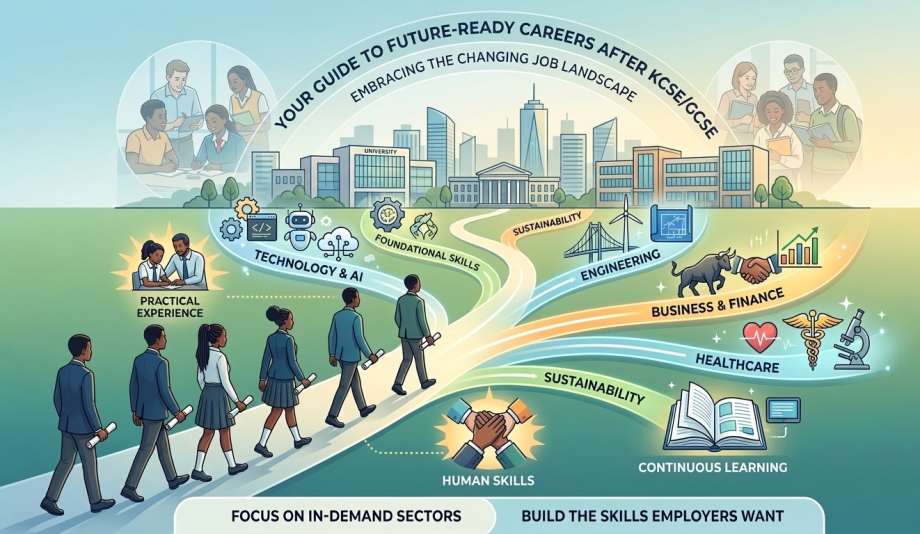
Your Guide to Future-Ready Careers After KCSE/GCSE
Welcome, learners! Finishing high school is a major milestone, and deciding what comes next is exciting and maybe a little daunting. The world of work is changing faster than ever, with new technologies like Artificial Intelligence (AI) transforming jobs and creating new opportunities. This guide uses recent insights from reports and surveys to help you think about these changes and choose a university course that sets you up for success in the future.
The Changing Job Landscape
Current Challenges
Surveys show that while students are optimistic about finding jobs after graduation, many employers in Africa are not convinced that higher education institutions are preparing graduates well for the job market. More than one-third of employers surveyed believe the next generation of graduates cannot help their business grow. This means that the skills you gain in university are more important than ever.
What Employers Want
When employers look for new graduates, they seek a mix of skills. The most sought-after skills include communication skills, innovation and creativity, and analytical thinking. Other important skills employers look for are problem-solving and leadership. Crucially, 71% of employers surveyed in Africa say that they are more likely to hire a graduate with practical work experience. This was strongly echoed by employers in Kenya (92% are more likely to hire a graduate with practical experience).
The Impact of AI on Jobs
Reshaping Job Requirements – AI is rapidly reshaping job requirements. While some jobs may be displaced, new opportunities are emerging. The rise of generative AI is leading to a rapid evolution in the skills workers need.
Continuous Reskilling – More than half of employers believe that AI will require workers to reskill many times during their career.
Opportunities – However, AI also presents opportunities. While employers are concerned about AI widening wage gaps and potentially leading to fewer employment opportunities, over half see AI as an opportunity for their business.
Choosing Your Course
Focus on In-Demand Sectors and Skills – Consider popular choices and growing industries like engineering, banking/finance, and technology. Ensure the course teaches both technical skills (like computing and potentially AI/big data/networks and cybersecurity) and foundational skills such as leadership, critical thinking, problem solving, communication, and innovation. Look for courses that integrate digital competencies throughout the curriculum.
Prioritize Practical Experience – Seek out institutions that offer work-based learning opportunities, such as internships, apprenticeships, or projects with businesses. Universities partnering with employers to provide this are better positioned to prepare graduates.
Focus on Human Skills – As AI handles more routine tasks, skills that AI cannot master, such as critical thinking, entrepreneurship, creative problem-solving, resilience, curiosity, and adaptability, become even more valuable.
Embrace Lifelong Learning – The future workforce will require continuous learning and reskilling. Choose a course and institution that instils a growth mindset and the importance of adaptability.
Recommended Course Areas
Technology & Software
These are growing sectors, and technological literacy is increasingly crucial, expected to increase in importance by 2030. Examples include: AI and Big Data, networks and cybersecurity, and software engineering with specialization tracks like machine learning, computer science and information & communication technology.
Engineering
It plays a crucial role in driving economic growth. As technology rapidly transforms industries, engineers are at the forefront of innovation4designing solutions. Examples include: Civil engineering, electrical engineering, electrical and electronics, mechanical engineering, mechanical and manufacturing, civil and construction, biosystems, and geospatial and space technology.
Business & Finance
This sector is also expected to see significant revenue growth. Consider areas like project management or supply chain management, international business & trade, entrepreneurial leadership, business management, and human resource management.
Healthcare
Pursuing healthcare courses is more important than ever as global health systems adapt to emerging challenges like pandemics, aging populations, and mental health crises. Courses in medicine, dentistry, nursing, veterinary medicine, and pharmacy.
Technical and Vocational
This is one category that is usually underrated. They are skills-based, practical, and directly linked to the job market. These are far from being replaced by AI, hence the rise in demand. These include agriculture, agribusiness, culinary arts, hospitality, plumbing, teaching, carpentry & woodwork, and driving & vehicle operation.
Sustainability
This is another sector that is rapidly growing. Courses under sustainability are essential for equipping students to tackle the urgent environmental and social challenges facing the world today. As industries shift towards greener practices and governments prioritize climate action, there’s a growing need for professionals. These include sustainable development, renewable energy, conservation, environmental education and sustainability, sustainable management and operations, climate change, environmental management, agroforestry, and conservation courses.
Moving Forward
Remember, these are just a few suggestions. It9s up to you to carry out intensive research in what you9re interested in and make a wise decision.
Research Your Options -Choosing your university course is a big decision. It’s about finding a path that
aligns with your passions and interests while also equipping you with the skills needed for the future workforce.
Seek Guidance – Talk to current students, alumni, and professionals in fields you’re interested
in. Research university curricula carefully to see how they integrate the skills and experiences employers are demanding.
Consider Practical Experience – Consider institutions that partner with businesses and offer work-based
learning. By making informed choices now, you can build a future where your talents thrive in Africa and beyond.
Good luck with your decision!
Sources:
• African Leadership University. (n.d.). African Leadership University (ALU) | Bachelor’s degree Program.
• African Leadership University. (2025). The ALU 2025 Africa Workforce Readiness Survey Report.
• Deloitte Insights. (n.d.). Future of work.
• Jomo Kenyatta University of Agriculture and Technology. (n.d.). Programmes – Bachelor.
• Kenyatta University. (n.d.). ACADEMIC PROGRAMMES.
• McKinsey & Company. (n.d.). Future of Work | McKinsey & Company.
• PwC. (n.d.). Workforce of the future – The competing forces shaping 2030.
• University of Nairobi. (n.d.). [ALL PROGRAMMES].
• World Economic Forum. (2025). Future of Jobs Report 2025.